FPO vs IPO in Nepal – Key Differences Every Investor Should Know

 July 31, 2026 2:23 pm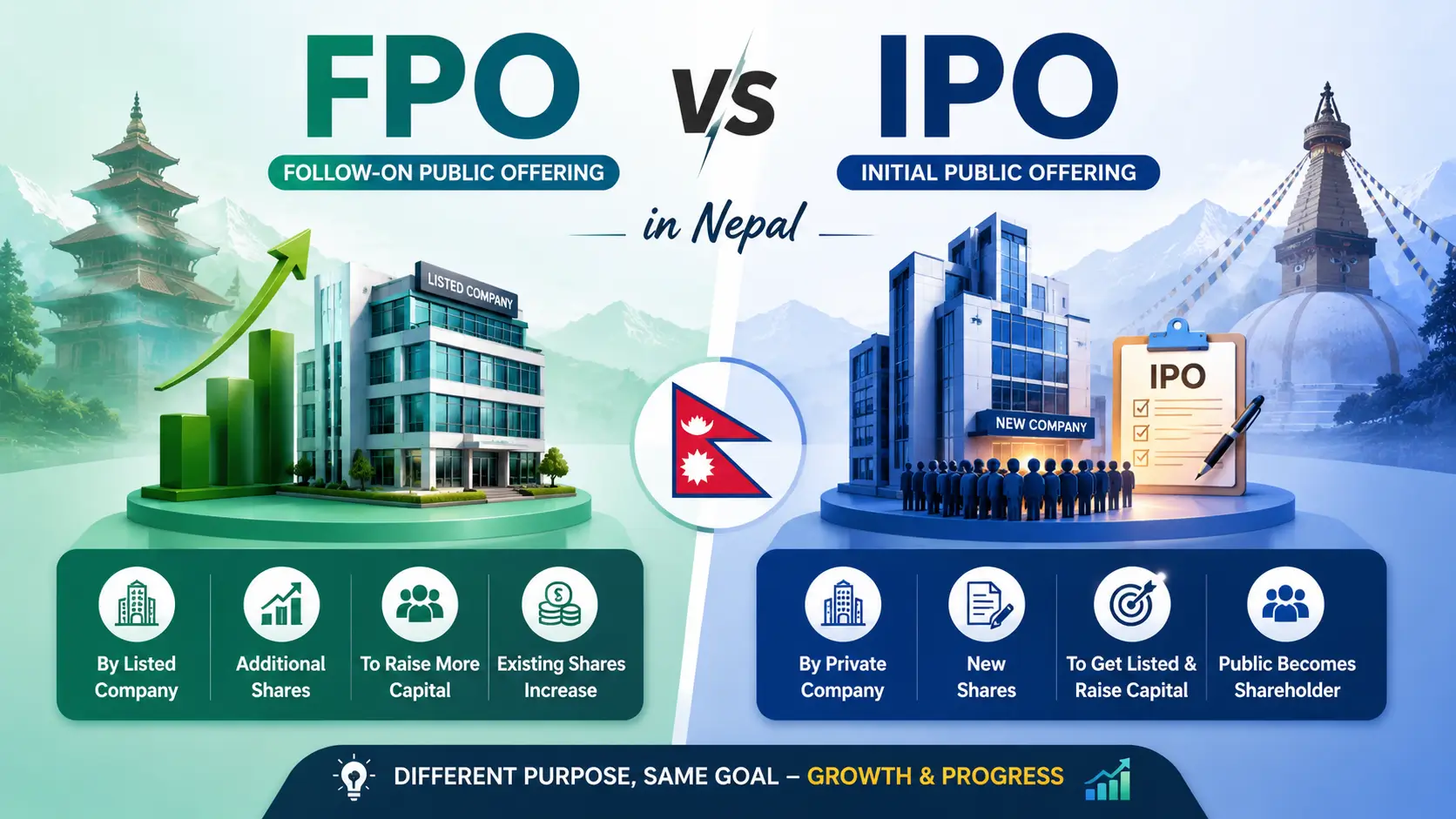
FPO vs IPO in Nepal: If you have been investing in Nepal’s stock market for a while, you have probably come across both IPO and FPOs. Many investors apply for IPOs regularly but skip FPOs sometimes because they do not fully understand how FPOs work or how they are different.
This guide breaks down everything you need to know about IPO and FPO in Nepal what each one is, how they differ, how to apply, and which one makes more sense for your investment goals.
What is an IPO in Nepal?
IPO stands for Initial Public Offering. It is the very first time a company offers its shares to the general public.
Before an IPO, a company is privately owned, meaning only its founders, early investors, or promoters hold shares. When the company decides to raise funds from the public, it goes through the IPO process, lists on NEPSE (Nepal Stock Exchange), and becomes a publicly traded company.
Why do companies issue IPOs in Nepal?
- To raise capital for business expansion or new projects
- To meet regulatory paid-up capital requirements set by SEBON or Nepal Rastra Bank
- To allow promoters to partially exit their investment
- To improve public visibility and credibility
Once an IPO is issued and the result is published, allotted investors receive shares in their DEMAT account. You can check your allotment status on iporesult.cdsc.com.np. Read our full guide on Nepal IPO result check.
What is an FPO in Nepal?
FPO stands for Follow-on Public Offering (sometimes also called Further Public Offering). It is when a company that is already listed on NEPSE issues additional shares to the public.
Unlike an IPO, an FPO is not a company’s first entry into the stock market. The company already has a trading history, published financials, and a known share price on NEPSE.
Why do companies issue FPOs in Nepal?
- To raise additional capital for expansion or new projects
- To reduce debt by converting it into equity
- To meet increased regulatory capital requirements
- To fund acquisitions or joint ventures
A key rule set by SEBON is that a listed company can only float another FPO five years after its previous FPO. This prevents companies from repeatedly diluting shareholder value.
FPO vs IPO – Key Differences at a Glance
| IPO | FPO | |
|---|---|---|
| Full form | Initial Public Offering | Follow-on Public Offering |
| Who issues it | Private company going public for the first time | Already listed company issuing more shares |
| Company track record | No public history available | Financials and performance are publicly known |
| Share price basis | Set by merchant banker based on valuation | Based on market price, book value, and SEBON formula |
| Risk level | Higher no prior market data | Lower investors can study existing performance |
| Premium on shares | Usually at face value (Rs 100) | Can be issued at a premium above face value |
| Shareholder dilution | No existing public shareholders | Dilutes existing shareholders’ ownership |
| Frequency limit | No specific limit | Can only issue FPO every 5 years per SEBON rules |
| Application process | Through MeroShare using CRN | Through MeroShare using CRN (same process) |
How is the FPO Price Determined in Nepal?
This is one of the biggest differences between an IPO and an FPO in Nepal.
For an IPO, the share price is usually set at face value Rs 100 per share for most companies. The merchant banker determines this based on the company’s valuation and SEBON guidelines.
For an FPO, SEBON requires listed companies to calculate the issue price using four specific methods:
- Capitalized earnings: based on the company’s profit
- Net worth per share (Book value): based on total assets minus liabilities
- 180-day average market price: average of the last 180 trading days on NEPSE
- Discounted cash flow (DCF): estimated future cash flows brought to present value
The company calculates a share price using all four methods and takes the average. This becomes the FPO issue price. Because of this formula, FPO prices are often higher than Rs 100, sometimes significantly higher if the company has strong fundamentals and a high market price.
Is the FPO Application Process Different from IPO?
No, the application process for both IPO and FPO in Nepal is the same. Both are applied through MeroShare using your DEMAT account and CRN number.
Here is a quick summary of how to apply:
- Log in to MeroShare
- Go to My ASBA → Current Issue
- Select the IPO or FPO you want to apply for
- Enter your CRN number and the number of units
- Submit the application
Your application amount is blocked in your bank account through the C-ASBA system it is not deducted unless you are allotted shares.
Before you apply, make sure your CRN number is active read our guide on Nepal IPO CRN number and how to get it.
Who Can Apply for FPO in Nepal?
Both existing shareholders of the company and general public investors can apply for an FPO in Nepal.
Unlike right shares which are exclusively offered to existing shareholders, FPOs are open to all registered investors who have an active DEMAT account and CRN number linked to MeroShare.
This means even if you do not currently hold shares in the company, you can apply for its FPO just like you would apply for any IPO. For a full walkthrough, see our guide on how to apply for IPO using MeroShare.
What Happens to Existing Shareholders During an FPO?
When a company issues an FPO, it creates new shares and adds them to the total supply. This means existing shareholders now own a smaller percentage of the company a process called dilution.
For example, if a company had 10 lakh shares outstanding and issues 2 lakh new shares through an FPO, each existing shareholder’s percentage ownership drops even though they still hold the same number of shares.
However, dilution is not always bad. If the company uses the FPO funds well, to expand operations or reduce expensive debt, the company’s overall value can grow, which benefits all shareholders in the long run.
Also, FPOs issued at a premium actually increase the company’s reserves and net worth per share, which can be a positive signal for long-term investors.
IPO vs FPO – Which is Better for Investors in Nepal?
There is no single correct answer it depends on your investment goals and risk appetite.
IPOs may suit you if:
- You want to get in early at face value (Rs 100) before the market price rises
- You are comfortable with some uncertainty about future performance
- You are applying for well-known sectors like hydropower or microfinance where listing premiums are common
FPOs may suit you if:
- You prefer investing in companies with a proven track record
- You want to study the company’s NEPSE trading history before investing
- You are comfortable with a higher issue price in exchange for reduced uncertainty
One practical advantage of FPOs is that you can research the company’s actual performance before applying. With an IPO, you are relying on prospectus projections. With an FPO, years of financial data and NEPSE price history are already publicly available.
Sectors That Commonly Issue FPOs in Nepal
Based on NEPSE listing history, these sectors frequently issue FPOs in Nepal:
- Microfinance institutions (MFIs): often required to increase paid-up capital as they grow
- Development banks: expanding operations and meeting NRB capital requirements
- Insurance companies: both life and non-life insurers issue FPOs to meet SEBON regulations
- Hydropower companies: issuing FPOs after completing the IPO stage and requiring further capital for expansion
How to Check FPO Result in Nepal
The FPO result is published the same way as an IPO result. Once the allotment is complete, you can check your status on iporesult.cdsc.com.np using your 16-digit BOID number.
You can also check through MeroShare by going to My ASBA → Application Report and selecting the FPO you applied for. If you have not yet opened a DEMAT account, read our guide on how to open a DEMAT account in Nepal.
FAQs About FPO vs IPO in Nepal
Can I apply for both IPO and FPO at the same time? Yes, as long as they are different companies and the application windows overlap, you can apply for multiple offerings simultaneously through MeroShare.
Is the minimum application unit the same for IPO and FPO? For most offerings in Nepal, the minimum application is 10 units. However, this can vary depending on the company and SEBON approval. Always check the specific prospectus before applying.
Will my blocked amount be refunded if I am not allotted FPO shares? Yes. Just like IPOs, FPO application amounts are blocked through C-ASBA and automatically released to your account if you are not allotted shares. No manual refund request is needed.
Can I sell FPO shares immediately after listing? Yes. Unlike right shares which sometimes have lock-in conditions for promoters, retail investors can sell FPO shares on NEPSE from the first day of listing.
Where can I find upcoming FPOs in Nepal? Upcoming FPOs are announced on the SEBON website and the NEPSE website. Issue managers also publish notices in national newspapers and on their own websites.
Conclusion
Both IPOs and FPOs are important parts of Nepal’s primary market. IPOs give investors the chance to participate in a company’s public debut often at face value with the potential for a listing premium. FPOs offer a safer entry point into an already established company, though usually at a higher price.
The application process for both is identical through MeroShare using your DEMAT account and CRN number. And once the result is out, you can check your allotment status on iporesult.cdsc.com.np.
Understanding the difference between the two helps you make more informed decisions about which offerings to apply for and what to expect from each investment.

Asmita Neupane 
I’m Asmita Neupane, a content writer at IPOResult.org with 2–3 years of experience in IPO results and Nepal’s stock market. I simplify topics like DEMAT, BOID, and investing so readers can easily understand them. My focus is to provide clear, accurate, and helpful financial information.